CCB and Legislative Update
The 2026 General Assembly passed its crossover deadline, with Bill S.278, the leading cannabis legislation, receiving last-minute amendments before moving from the Senate to the House. The Cannabis Control Board's March meeting included updates on the Cannabis Business Development Fund from the Agency of Commerce and Community Development, and it held discussions on various issues, including minor cannabinoids like CBD and CBG in cannabis products. Legislators are also working to re-establish an in-state hemp market amid uncertainty in Washington, D.C.
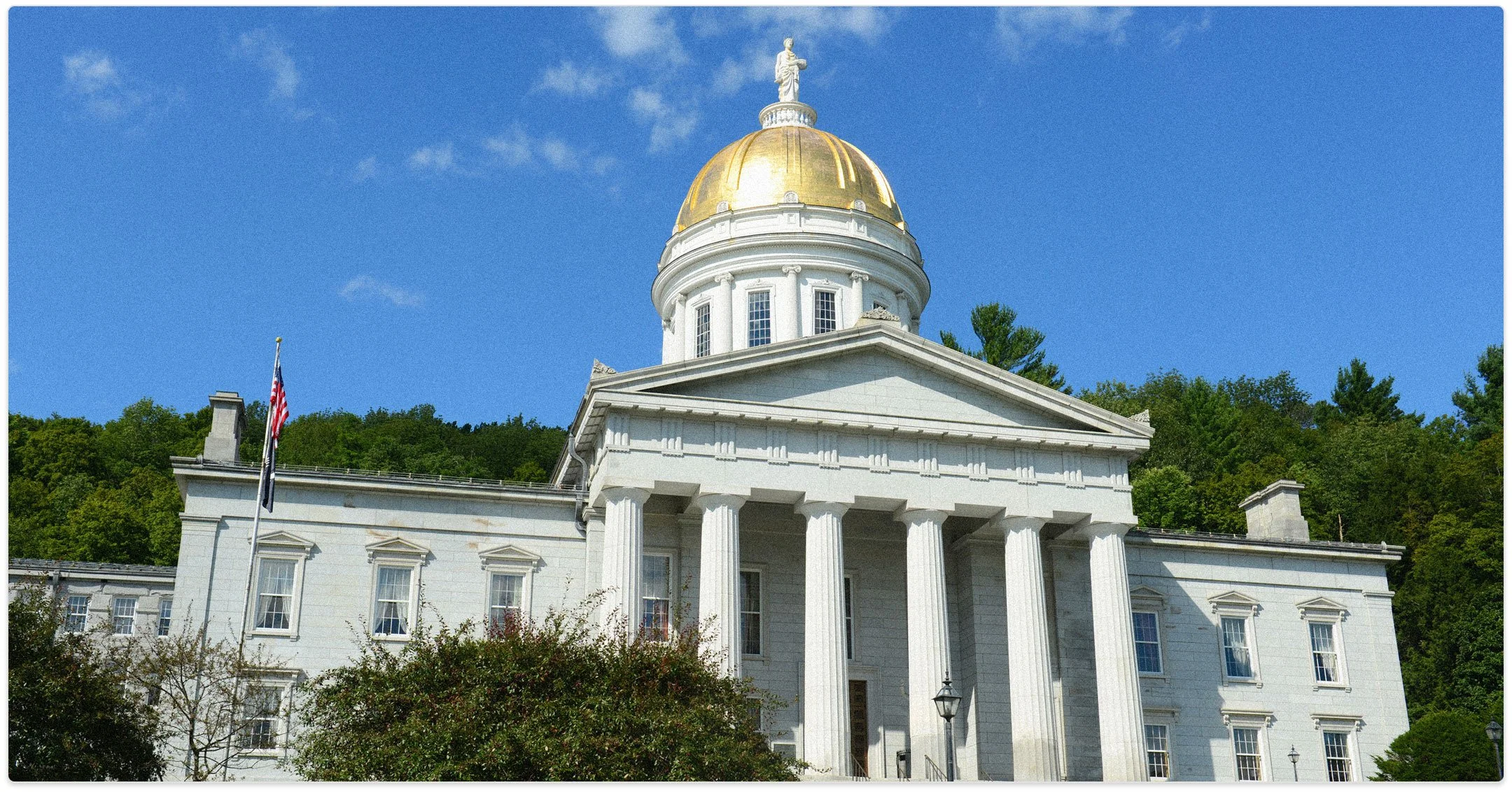
The Vermont State House in Montpelier in the spring.
“In its current form, Bill S.278 offers important yet marginal progress through proposals such as increasing possession and transaction limits, protections for non-homeowners, limited direct-sales proposals for producers, an easier process for towns to opt into retail sales, and a producer cooperative. However, the bill still falls short of the foundational reforms needed to ensure fairness and equity across the market and enable a sustainable, thriving market.”
The State House
On Friday, March 27, after nearly three months in the Senate chamber, Bill S.278, the leading cannabis legislation this session, passed the Senate and was sent to the House, where it was referred to the House Committee on Government Operations and Military Affairs. The bill has changed significantly since its introduction in January, with a handful of amendments added to the legislation in the final week it was in the Senate.
The last-minute amendments to Bill S.278 before passing out of the Senate include a mechanism to establish a regional compact with neighboring adult-use states should the federal government legalize cannabis, explicit protections for non-homeowners by preventing property owners from prohibiting non-lighted consumption, and places the burden on them to prohibit smoking, and a reduction to outdoor cultivator license fees.
Other changes to the legislation that occurred in the final weeks in the Senate chamber include the Senate Committee on Appropriations removing $1M funding for the Cannabis Business Development Fund, and $1.6M for the Land, Access, and Opportunity Board, and removing the THC cap reforms.
In its current form, Bill S.278 offers important yet marginal progress through proposals such as increasing possession and transaction limits, protections for non-homeowners, limited direct-sales proposals for producers, an easier process for towns to opt into retail sales, and a producer cooperative. However, the bill still falls short of the foundational reforms needed to ensure fairness and equity across the market and enable a sustainable, thriving market.
As the legislation progresses in the House, it is important to acknowledge that the bill will continue to change. Historically, the House has been less inclined to engage with cannabis legislation at the level of discussion that the industry requires. We expect to face challenges as we seek to strengthen the bill's proposals and incorporate essential reforms, including those related to agriculture, equity, antitrust issues, and the medical cannabis program. It will take the community, all license types, patrons, and allies of the plant to engage the House and rally to improve the bill and see it through. It will be essential for the community to actively participate in discussions with the House to ensure the successful passage of this important market expansion bill. Gain an in-depth understanding of Bill S.278 in our recent blog post.
The March CCB Board Meeting
The CCB's March Board Meeting opened on Wednesday, March 25, with Chair James Pepper announcing that the final version of the market supply and analysis by Cannabis Public Policy Consulting (CPPC), an update to the original 2022 analysis by VS Strategies, now called Strategies 64, was complete and available on the agency's website. CPPC's analysis includes a range of conclusions on the Vermont-regulated and unregulated markets, which it arrived at through a series of questionnaires. We examined CPPC's preliminary report from the CCB's January Board meeting in a previous blog post. The Board then heard an update to the Cannabis Business Development Fund, discussed various issues, and the Executive Director closed out the meeting with the monthly report and reviewed staff recommendations for social equity status and license applications.
The Agency of Commerce and Community Development Updates
Nathan Davidson from the Department of Economic Development, under the Agency of Commerce and Community Development, which administers the Cannabis Business Development Fund, presented updates on the fund. Nathan shared that the ACCD is constantly considering new ways to use the fund to support eligible participants and collaborated with New England Cannabis Convention, a trade show taking place in May in South Burlington, to offer reduced booth registration costs and reimbursement up to $500 for marketing materials for the event to 4 Social Equity applicants.
Minor Cannabinoids in Cannabis Products
After the ACCD presentation, the commissioners resumed their discussion on the use of minor cannabinoids, such as CBD and CBG, in cannabis products. This topic was initially raised during their February meeting.
The discussion began with the commissioners considering a blanket waiver for rule 2.6.4, which currently prohibits such intermediaries. They expressed concerns about allowing minor cannabinoids into the supply chain, including the legitimacy of out-of-state COAs and potential health risks associated with certain compounds. Compliance Agent Andy Chevrefils joined the conversation and highlighted that these compounds are already included in the formulations of registered cannabis products. When the commissioners inquired, Agent Chevrefils noted that the COAs for these ingredients are inconsistent.
Following the discussion, the Board voted to grant a waiver for the "big five" minor cannabinoids, as Chair Pepper referred to them: CBD, CBN, CBG, CBC, and THCV. This waiver is contingent upon meeting additional criteria: the products must be manufactured in a cGMP facility, tested by a laboratory regulated by the Board, either in-state or, if out-of-state, an ISO 17025-certified lab, and the COAs must be available upon request from the Product Registration team. Additionally, the product labels must clearly indicate the presence of these additives.
Input Substitution Concerning Product Registration
The Board resumed this important discussion on when and how input substitution changes require a change in product registration, and the product registration team's desire for greater traceability.
Compliance Agent Andy Chevrefils framed the discussion as the product registration team sees it, distinguishing the different inputs used in product formulation from the thresholds for new product registration and the need for a unique identifier for such changes. The examples mentioned included when the strain, flavor, or blend changes that typically warrant a new product registration, where, by contrast, different batches of distillate used to create beverages would not trigger a new product registration.
The Board decided there was no decision or vote on this issue, to rely on existing guidance, and possibly revisit it in the next rules amendment process.
Ownership Changes in Guidance
This matter concerns guidance on the non-transferability of licenses among commonly held corporations. Chair Pepper opened the discussion by stating a desire to memorialize these procedures after the licensing department fielded several questions about ownership changes and innocuous requests. General Counsel Gabe Gilman reviewed the issue, stating that the document puts in writing answers to questions the licensing team commonly receives. The Board voted to amend its guidance to clarify its procedures around the non-transferability of licenses. It's important to underscore that this is just a point of clarity and there is no policy change here.
Additive List for Inhalables
This issue concerns Rule 2.6.4, which states that for cannabis products intended for inhalation, the Board will maintain a list of approved and disapproved ingredients, but it has not yet done so. This list does not apply to edibles, which have their own schedule of approved ingredients.
The Board reviewed and discussed a list of approved and disapproved ingredients recommended by the product registration team, what other states do, and the potential impact on licensees. Bringing the discussion to a close, the Board voted to approve the disapproved list, then decided to postpone voting on the approved ingredient list to hear more feedback from the industry.
The Executive Director Report
After a lengthy discussion and vote on those five discussions, the Executive Director presented the monthly Executive Director Report. We highlight some key findings below.
There are 562 active total licenses;
345 active total Cultivators, a decrease of 7 license from last month;
0 Integrated;
92 Manufacturers, an increase of 1 license from last month;
110 Retailers, an increase of 1 license from last month;
2 Testing Labs;
8 Wholesalers;
5 Propagators;
347 Standard licensees, 130 Economic Empowerment licensees, and 85 Social Equity licensees.
Hemp Market Legislation
In November 2025, a federal spending package (H.R. 5371) was signed into law to reopen the government. This package includes provisions that will effectively prohibit hemp products starting November 12, 2026, by changing the 2018 Farm Bill definition of the delta-9 THC threshold for hemp from 0.3% THC on a dry-weight basis to 0.4 mg THC per container. While there are indications from the White House and Congress of efforts to overturn this change to the THC threshold, if states don't act to support their local hemp farmers and manufacturers, they will face a significant disruption to their ability to produce and sell products that exceed 0.4 mg THC per container come November.
As a result, in February, the Senate Committee on Agriculture drafted a proposal in Bill S.323, an act relating to miscellaneous agricultural subjects, to restore oversight of Vermont's state hemp market from the USDA. The original version of the proposal statutorily transfers hemp oversight to the CCB and defines a market structure with grower and processor permits that rely on the agency's processes and procedures for the adult-use cannabis market, including testing and product registration.
An informal group of local small hemp farmers and product makers began organizing with Rural Vermont, VGA, and other local agricultural groups to bring their voices into the policy discussion and to help inform policymakers on the often complex issue. This group has developed a coherent and reasonable proposal to restore an in-state hemp market equitably.
This discussion of hemp market policy is important. Not only because participating in the process will help us ensure the hemp market remains in harmony with the adult-use cannabis market, but also because it ties into a larger conversation about the current state of regulated cannabis markets and the necessity to revisit their foundational structures.
Meeting and Resource Links
Watch the March 25, 2026 Board Meeting on YouTube.
Read the March 25, 2026 Executive Director report (PDF).
The State House bill page for S.278, an act relating to cannabis.
The State House bill page for S.323, an act relating to miscellaneous agricultural subjects.