
What’s In Bill S.278?
On Wednesday, January 21, Senator Ram Hinsdale introduced Bill S.278, an omnibus bill that is emerging as the leading cannabis legislation this session. Bill S.278 is a market-expansion bill that seeks to increase the market's economic potential, capture a larger share of the customer base, and generate greater potential tax revenue, as well as complete the foundational work that remains, such as direct sales options for producers, consumption, community, and industry reinvestment, retail opt-in reform, and more.
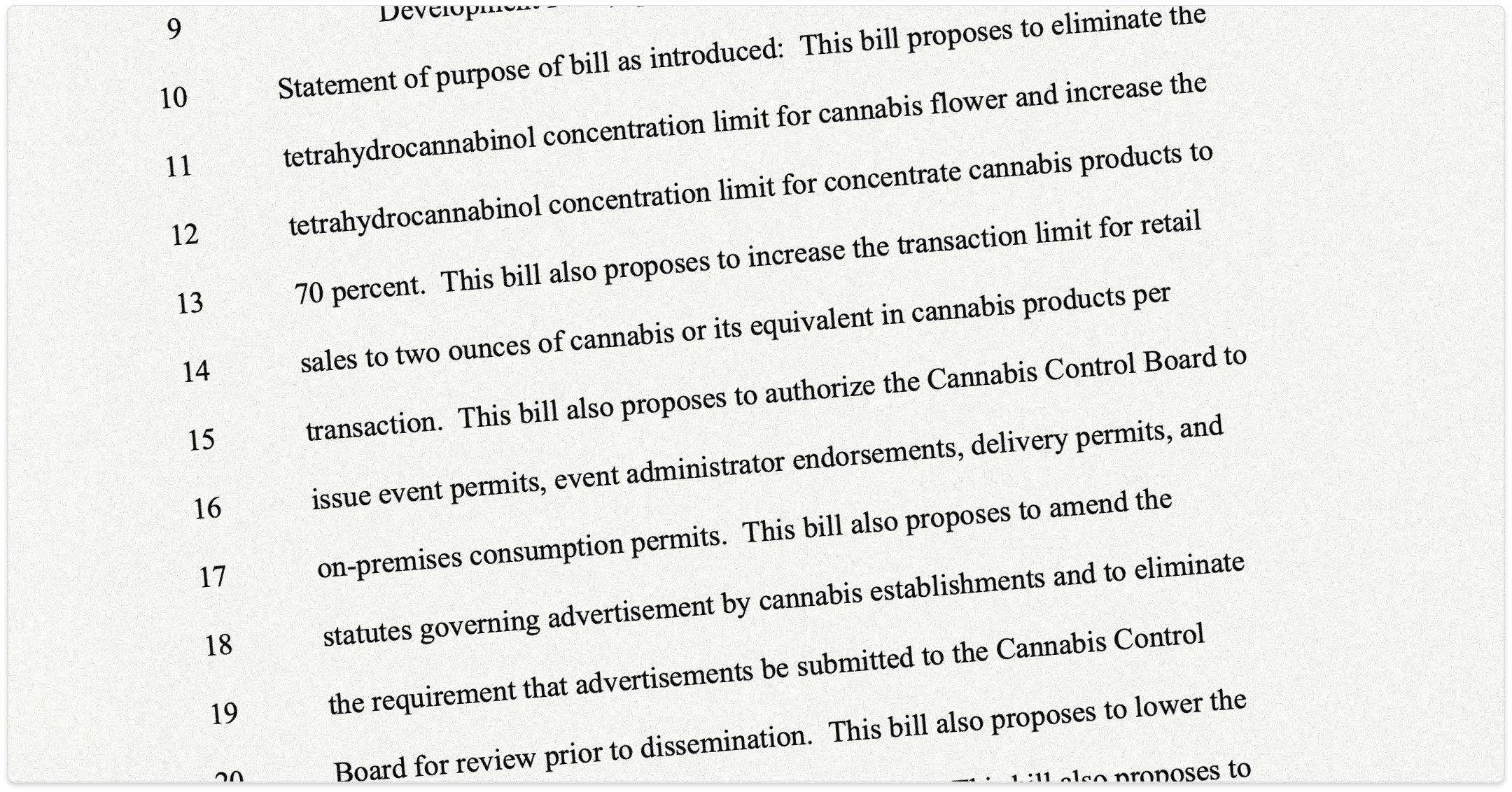
A page from Bill S.278, An Act Relating to Cannabis.
“We break down all 18 sections of Bill S.278 as introduced, so everyone can become well-informed about this important piece of legislation as it works its way through the State House this year. We worked with the lead sponsor of Bill S. 278 throughout its development, so we have a close and accurate understanding of the legislation.”
Bill S.278, An Act Relating to Cannabis, presents much greater potential for the community than the previous cannabis bills introduced over the last three years. While this significant improvement does not guarantee outcomes, it increases the likelihood of securing the outcomes we seek. For example, instead of spending time during the session amending a bill with priorities such as retail opt-in reform or direct sales options for producers, we now have those policy proposals in the bill at the time of introduction, allowing us to spend the time refining the language and working to secure its passage.
Bill S.278 is a market-expansion bill. That is, it seeks to increase the market's economic potential, capture a larger share of the customer base, and generate greater tax revenue by completing the foundational work that remains unfinished, such as implementing direct sales options for producers, addressing consumption, fostering community and industry reinvestment, reforming retail opt-in, and more.
Bill S.278 As-Introduced Breakdown
We break down all 18 sections of Bill S.278 as introduced, so everyone can become well-informed about this important piece of legislation as it works its way through the State House this year. We worked with the lead sponsor of Bill S. 278 throughout its development, so we have a close and accurate understanding of the legislation. Here is the current text of Bill S.278, and we encourage you to read the bill alongside the breakdown.
We also want to emphasize that the bill is still in its as-introduced form, meaning it is early in the process. Many of the sections or policy proposals may be rough, and we should anticipate that much of the language will change. We plan to propose comprehensive amendments to nearly every section of the bill, which we will cover in a future post.
Section 1
This section proposes repealing the 30% THC cap for cannabis, and increasing the 60% THC cap for solid concentrates to 70%.
Section 2
This section proposes increasing the total package THC limit from 100 to 110 mg.
Section 3
This section proposes increasing the retailer transaction limit to 2 ounces of cannabis and equivalent.
Section 4
This section proposes increasing the state possession limit to 2 ounces of cannabis.
Section 5
This section proposes increasing the state possession limit to 2 ounces of cannabis, and is a companion provision to Section 4.
Section 6
This section proposes a new license, an Event Permit, available to any cannabis establishment, such as a cultivator, manufacturer, or retailer. The concept limits events to 24 hours or less and to locations with access control, and tasks the CCB with developing rules for the new license, including a security plan, a safe transport plan, a product sale plan, a capacity and intent, with additional rules to be determined by the agency.
Section 7
This section proposes a new license, an Event Administrator Endorsement, available to any cannabis establishment, such as a cultivator, manufacturer, or retailer. The concept allows for sales, possession, consumption, and event allowances and shall remain in effect as long as the license to which it is attached. This section tasks the CCB with developing rules for the new license that mirror the Event Permit rules, and shall additionally specify the maximum number and frequency of events permitted.
Section 8
This section proposes another new license, a Delivery Permit, available to any cannabis establishment, such as a cultivator, manufacturer, or retailer. The concept allows sales via delivery to addresses in Vermont between 9 am and 5 pm, and the licensee or an employee must make all deliveries.
Section 9
This section proposes yet another new license, an On-site Consumption Permit, available only to retailers. The concept allows a licensed retailer in good standing to offer lounge-style consumption. Some other details include that an applicant must demonstrate that they own, rent, or lease premises; are capable of managing consumption in accordance with CCB-established rules; and are capable of dispensing food in a safe space. The On-site Consumption Permit would be valid for 12 months.
Section 10
This short section includes the fee schedule for the newly proposed licenses. The Event Permit fee is $250, the Event Administrator Endorsement fee is $500, the Delivery Permit fee is $500, and the On-premises consumption fee is $500.
Section 11
This section proposes changing the audience composition for advertisements from 15% to 30% of people under 21 years of age, repealing the CCB advertising approval process, and restricting advertisements from including THC levels, numbers, etc.
Section 12
This section proposes changing the audience composition for advertisements from 15% to 30% of those under 21 years of age, and is a companion provision to Section 11.
Section 13
This section proposes decreasing the cannabis excise tax from 14% to 10%.
Section 14
This section proposes that a town or city must place retail opt-in on the 2026 General Election (November) if the municipality has not already voted to opt-in.
Section 15
This section proposes including a municipality's charter in the CCB’s issuance of a license.
Section 16
This section proposes a one and two-year employee identification card, and the CCB may issue longer product registration durations at the same cost for products the agency deems low-risk and shelf-stable.
Section 17
This section proposes allowing Tier 1 Cultivators, Tier 1 Manufacturers, and Economic Empowerment applicants access to the Cannabis Business Development Fund.
Section 18
This section proposes a one-time transfer of $1m from the General Fund to the Cannabis Business Development Fund for 2027, and a one-time appropriation of $5.6m to the Land Access and Opportunity Board for 2027.
Conclusion and A Look Ahead
As we move forward, we acknowledge that Bill S.278 is a positive step and a welcome change from previous legislative sessions. However, there is still significant work to be done, such as adding new sections to the legislation to improve the medical program, implement automatic expungement, reform product registration, and more.
There is a lot of buzz, both inside and outside the industry, surrounding Bill S. 278, which is good! We anticipate a busy legislative session and look forward to working together as a community this year to secure long-sought fixes and improvements to the market.