
What’s in the Final Version of Bill S.278?
Bill S.278, the leading cannabis legislation this General Assembly, was voted out of the legislature on Friday, May 29, and will soon be sent to the Governor, who will then have five days to act. The version of Bill S.278 that the Senate passed differs from the version the House passed. Though the Senate version was missing several core reforms, such as funding for community and industry reinvestment and medical program improvements, it also included two direct sales proposals for producers that the House struck in the final hours of the session, preventing the Senate from restoring those absolutely crucial proposals. We felt it was important to provide a clear understanding of exactly what's in the bill, should it become law.
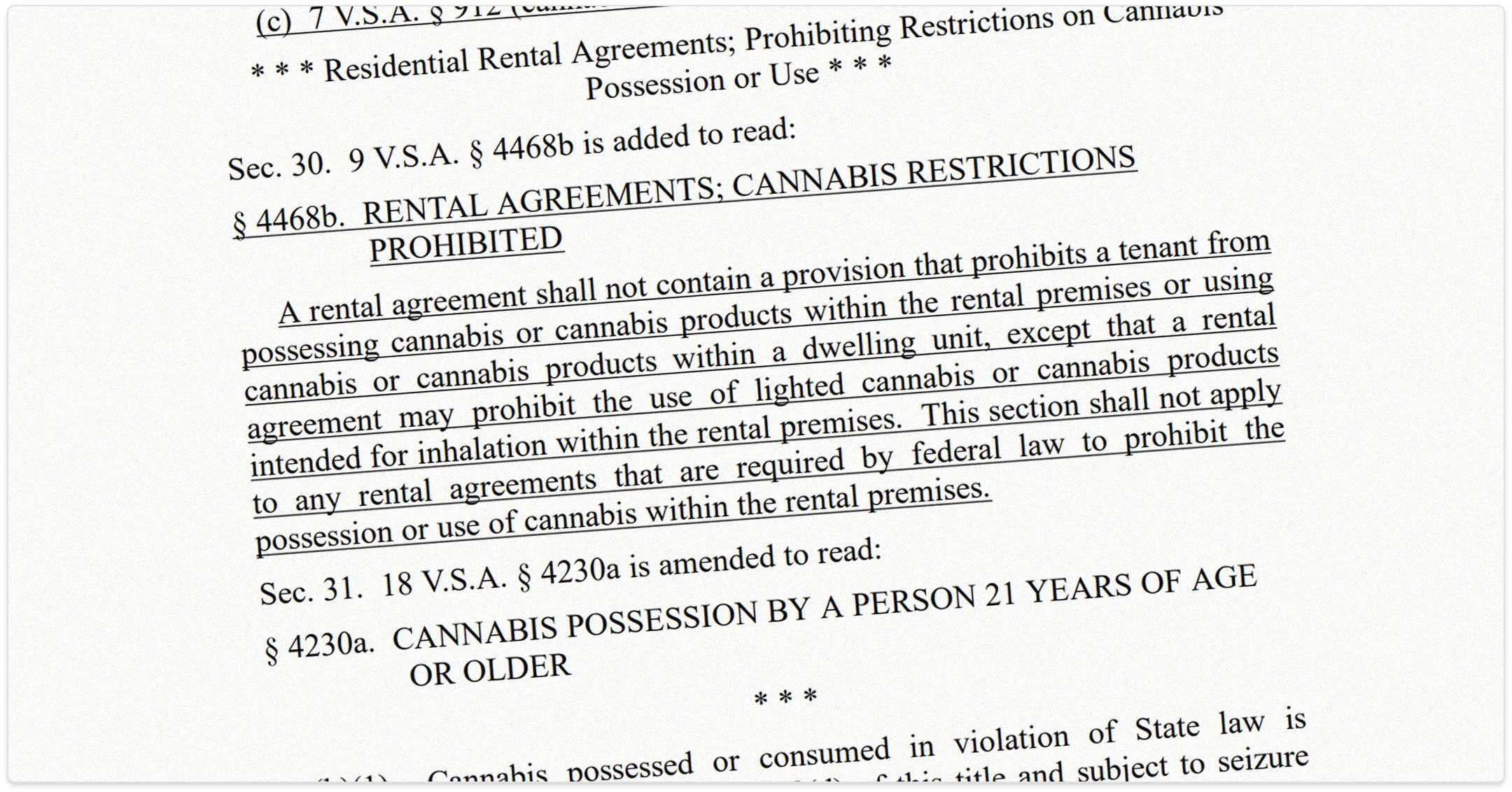
A page from the final version of Bill S.278, An Act Relating to Cannabis.
“It is important to note that the Senate listened to industry and consumer voices and created this pilot program to allow cultivators and manufacturers to sell their products directly to the general public. The Governor’s team did not object to this, but at the 11th hour, Representative Boyden (D, Lamoille-3) introduced an amendment to remove producers’ ability to sell in this pilot program. This single legislative action represents a tremendous blow to modest efforts to increase equity and fairness in the market.”
Bill S.278, An Act Relating to Cannabis, began as a market-expansion bill intended to increase the economic potential of the adult-use market, developed with input from industry stakeholders and the broader community. However, the Senate failed to include essential foundational reforms, such as allocating funds for the Cannabis Business Development Fund and community reinvestment, addressing public consumption, and improving the medical program. Despite this, the Senate sent the House a bill with numerous marginal improvements for the industry, its patrons, potential tax revenue, and to satisfy the original intent of the enabling statute to transition Vermont's legacy market producers, and by extension their customers, into the regulated market in an equitable manner in the interest of public safety.
Some key proposals in the Senate version of Bill S.278 that aimed to create a more equitable and prosperous market included: Establishing a pilot program that allows Tier 1 and 2 Cultivators and Manufacturers to sell directly to customers; Retail opt-in reform that simplifies the process of petitioning a town for retail operation; Increasing THC package limits; A direct sales event permit that would've allowed for events such as tasting events on farms, with sales – all which the House struck from the Senate version of the bill. This updated summary reflects the final version of the bill, which is now in the queue for the Governor's consideration.
A break down of the final version of Bill S.278
Below is a summary of each section of the final version of Bill S.278, as passed by the legislature. This summary is intended to help everyone become well-informed about this important legislation as the Governor deliberates on his decision on the bill. The Office of Legislative Counsel, which drafts statutory language for lawmakers, has not yet prepared the bill in its final form. However, we are well-versed in the legislation and are providing this accurate summary. Although Governor Scott has not yet considered the bill, we believe it is crucial to offer a clear understanding of its contents in case it becomes law. Additionally, we aim to address any misinformation circulating and inaccuracies in media reporting.
Section 1
This important section proposed increasing the total package THC limit from 100 to 200 mg. Note that this does not affect the individual serving limits. The House Committee on Government Operations and Military Affairs removed this section, it is not in the final version of the bill.
Section 2
This section proposes increasing the retailer transaction limit to 2 ounces of cannabis and equivalent in cannabis products.
Section 3
This section proposes increasing the state possession limit to 2 ounces of cannabis and 10 grams of hash, and is a companion provision to Section 2. Note that in statute, the word hash is often used in a broad context, whereas the CCB has created more narrow definitions.
Section 4
This section proposes increasing the state possession limit to 2 ounces of cannabis and 10 grams of hash, and is a companion provision to Section 2 and 3.
Section 5
This section proposes an Event Permit pilot program available only to Retailers. The concept limits events to 24 hours or less and to locations with access control, and tasks the CCB with developing rules for the new permit, including a security plan, a safe transport plan, a product sale plan, a capacity and intent, with additional rules to be determined by the agency. Retailers who sell at the event cannot also sell at their licensed location at the same time. There are to be no more than 10 public events each year over the course of two years. The permit costs $500, and consumption is prohibited. When the pilot ends after two years, lawmakers are to consider changes and codify the policy into law.
It is important to note that the Senate listened to industry and consumer voices and created this pilot program to allow cultivators and manufacturers to sell their products directly to the general public. The Governor's team did not object to this, but at the 11th hour, Representative Boyden (D, Lamoille-3) introduced an amendment to remove producers' ability to sell in this pilot program. This single legislative action represents a tremendous blow to modest efforts to increase equity and fairness in the market.
Section 6
This section proposed a new Delivery Permit pilot program, available to Tier 1 and 2 Cultivators and Manufacturers who do not also hold a retail license, which was the second direct-sales proposal the Senate sent the House. The House Committee on Government Operations and Military Affairs removed this section, it is not in the final version of the bill.
Section 7
This section proposes allowing Event Permit holders to collect the cannabis excise tax. Note that there are several technical provisions throughout the bill, such as this section, which serve as companion sections to enable the Event Permit proposal.
Section 8
This section proposes requiring Event Permit holders to maintain sales records and is another technical section to enable the Event Permit proposal.
Section 9
This section proposes allowing Event Permit holders to collect sales tax, and is another to enable the Event Permit proposal.
Section 10
This section proposes that the CCB start an abbreviated rulemaking process for the Event Permits by July 1, 2027, and submit a report to lawmakers assessing the new permit pilot programs by November 15, 2027.
Section 10a
This section proposes reducing the fees for Tier 1-5 Outdoor Cultivators by 50% – a Tier 1 fee would go from $750 to $375, Tier 2 from $1,875 to $925, Tier 3 from $4,000 to $2,000, Tier 4 from $8,000 to $4,000, and Tier 5 from $18,000 to $9,000. Note that this proposal does not affect the fees for Mixed or Indoor licenses. This proposal, should it become enacted, would go into effect on July 1, 2027.
Section 11
This section is a technical section that proposes stricking the Integrated License from law.
Note, that the Senate sent this Section 11 to the House with 3 different local control-related proposals, some we supported, such as adding Indoor Cultivators and Tier 1 Manufacturers to the list of entities exempt from most municipal bylaws that currently only apply to outdoor cultivators and making the retail opt-in process easier. The House Committee on Government Operations and Military Affairs removed these proposals from this section, they are not in the final version of the bill.
Section 12
This short section proposes changing the frequency of CCB reimbursements to a town for administrative overhead related to local control from quarterly to annually.
Section 13
This section proposes changing the employee ID card duration from 1 year to 2 years and increasing the fee from $50 to $100. It also proposes allowing product registration for more than one year at the same cost for products it defines as low-risk and shelf-stable through guidance.
Section 14
This section, along with several others throughout the bill, proposes removing the Integrated License type from the law. Note that several sections of this bill serve the same purpose because the policy appears in different places throughout the Vermont statute.
Section 15-22
These sections propose removing the Integrated License type from law, and are companion provisions to Section 14.
Section 23
This section proposes allowing Tier 1 Cultivators and Manufacturers, and Economic Empowerment applicants access to the Cannabis Business Development Fund. The House Committee on Government Operations and Military Affairs removed this section, it is not in the final version of the bill.
Section 24
This is a corrective section, at the request of the Tax Department, that proposes to make it explicit in law that licensees may deduct cannabis business expenses on state tax returns. No substantive change here.
Section 25
This is another corrective section, at the request of the Tax Department, that proposes to make explicit that cultivating cannabis outdoors, not just initiating cultivation, under the Value Appraisal Program, are subject to the rules under the CCB. No substantive change here.
Section 26
This is the final corrective section, at the request of the Tax Department, that proposes to allow it to share tax information with the CCB for tax administration purposes. No substantive change here.
Section 27
This section proposes establishing a new corporate registration for cannabis producer cooperatives. Currently, a producer cooperative corporation registration is available to individuals engaged in the production of farm products and handmade products. This section allows cannabis cultivators to access the same corporation registration type, called a cannabis cultivation cooperative corporation.
Section 27a-27b
These sections propose a mechanism to establish a regional compact with neighboring adult-use states should the federal government legalize cannabis.
The proposal provides flexibility dependent on the governor to enter into a compact in the future, with the intention to establish requirements for compatibility between state laws as members of the compact, such as packaging and licensing, and to what extent other state licensees may operate in the state, and allows the CCB to be the authority over such matters.
Section 28
This section included proposals for appropriations for the Cannabis Business Development Fund and the Land Access and Opportunity Board. The Senate Committee for Appropriations removed this section, it is not in the final version of the bill, legislators chose not to fund the Cannabis Business Development Fund this year.
Section 29
This section includes the repeal dates for some of the proposals in the legislation – the Integrated License is repealed on July 1, 2026; a non-substantive hemp-related technical provision in law gets repealed on July 1, 2026; and the Event Permit pilot programs is repealed on July 1, 2028.
Section 30-31
These sections propose explicit protections for non-homeowners by preventing property owners from prohibiting non-lighted consumption, and places the burden on them to prohibit smoking.
Section 32
This final section proposes the enactment dates for the proposals in the legislation – the Tax Department’s Section on household income and cannabis business expenses deduction retroactively on January 1, 2025, and for household income received beginning in the 2025 calendar year and shall apply to property tax credit claims filed on and after January 1, 2026; the fee changes for production registration as proposed in Section 10a go into effect on July 1, 2027; the fee reduction for outdoor cultivators as proposed in Section 13, go into effect on July 1, 2027. The rest of the bill goes into effect upon enactment.
Conclusion and A Look Ahead
This 2026 legislative session marked the second year of the biennium. It yielded several key takeaways that can help illuminate a path forward to continue advancing to fight to make the market what it needs to be.
Putting policy aside for a moment, we witnessed a shift in the legislative procedure for cannabis legislation this General Assembly. This year, instead of starting the cannabis bill in the House, lawmakers chose to introduce it in the Senate. As a result of this change in procedure, we saw an inclusive policy formation process take place, one that included industry stakeholders and community input. While it was not without its faults, the outcome of this new process produced legislation that was more progressive and better met the needs of the industry and its consumers than cannabis legislation over the past 3 years. We plan to continue advocating for this direction and to influence the legislative process to serve the regulated market better.
While the House carried itself in a manner consistent with previous years, it is crucial to highlight that, due to the procedural change, the public can now clearly identify the different outcomes between the two chambers, which serves as a foundation for continuing to improve the climate for cannabis legislation in the State House.